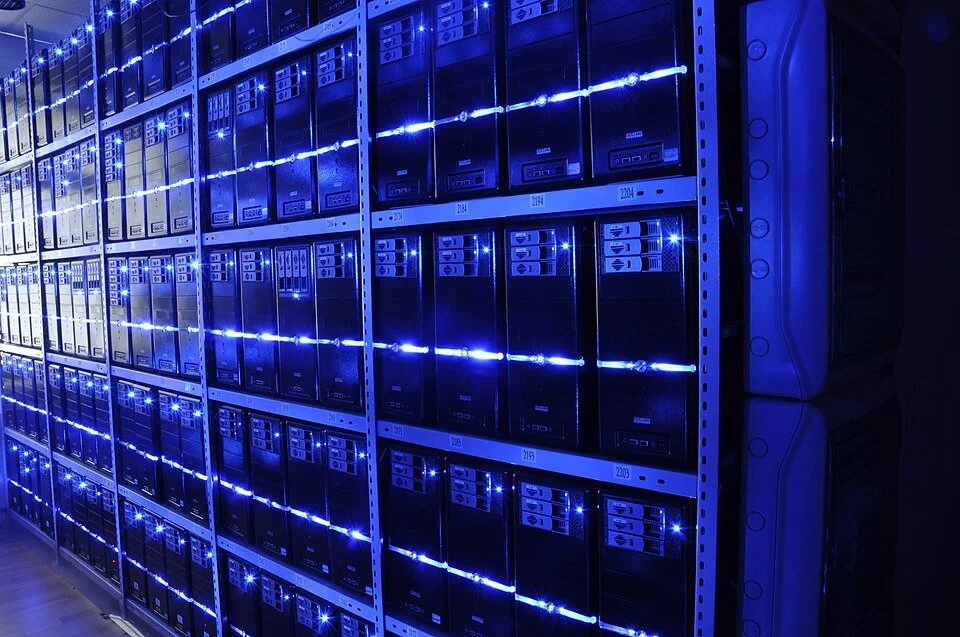
It was a post about an old growth forest being cut down to build a data center that brought me to my knees in grief. The anguish I’ve been experiencing over the destruction of the planet has been building in me for years, decades even, as I’ve slowly watched the land and water that I love be destroyed bit by bit and at an ever-increasing rate. So, reading about another forest being devastated and for yet another data center was nothing new, but it was the last in an accumulation of sorrow and rage that left me feeling that I could no longer bear the weight of it. The loss of centuries of growth of arboreal ancestors was shattering in itself, but it was the purpose of this annihilation that ultimately undid me – the new idol that has taken the world by storm – artificial intelligence – the latest iteration of the Windigo[i], destroying the earth and waters in its greed.
Years ago, long before the introduction of AI, one of my students, a computer science major, did his ecofeminism final project on the environmental impact of computers and the internet. The other students and I were all a bit surprised. Wasn’t the computer revolution supposed to be better for the environment, reducing the destruction of forests and the need for fossil fuels since we no longer needed so much paper and transportation for books and newspapers and letters and other ways to communicate with one another? No, he warned, because of the vast amounts of electricity and water needed to run data centers. It’s been on my mind ever since.
Now comes AI, with its need not just for data centers, but hyperscale data centers, hundreds of them, thousands, each needing vast amounts of electricity and water. According to a recent UN report, AI-related water consumption alone could equal the basic annual domestic needs of 1.3 billion people by the end of the decade. Date centers pollute the waters with PFAS and nitrates, the air with toxins, the area with heat and light and noise that can be seen and heard for miles. Forests and wetlands and habitats for thousands and millions of beings – from the tiniest microorganisms to deer, bear, wolves, and eagles -- are destroyed to accommodate the acreage needed for their construction.
And for what? For people to access more information more quickly and ostensibly more accurately? For machines to do repetitive tasks? For robots to write students’ papers for them? For computers to create pieces of music and works of art? For algorithms to tell you who you should vote for? For humans to let their brains atrophy and their analytical and critical thinking skills and their capacities for reflection and discernment and self-expression die off? For person-to-person connections to be replaced with conversations with Claude?
Resistance to hyperscale data centers has loomed large in our neighboring town of Hermantown where a proposed Google data center would cover over 400 acres and requiring an estimated 500 megawatts of electricity. In addition to the noise, light, and heat pollution the proposed data center would impact the Midway River watershed, including not only the Midway River, but also two major cold-water brook trout creeks, 48 tributaries, 58 acres of wetlands, and the entire St. Louis River watershed which flows directly into Lake Superior and from there to all of the Great Lakes and the Atlantic Ocean. Three quarters of the residents of Hermantown oppose the proposed data center and hundreds of people showed up at multiple protests, attempting to voice their opposition all the while the Hermantown City Council kept changing the date for the final hearing before the vote on the proposal and ultimately allowing only a fraction of those who wanted to speak to do so. And despite all the very real and documented concerns and constituent disapproval, the council voted unanimously for the data center. In the ostensible hope of Google funneling more dollars into the local economy, they are ransoming the future of their children and generations to come.
At the same time, I hear friends and associates blithely talking about how they are using AI for this and that, nothing of any major importance, no groundbreaking discoveries that could save the planet from the tool that discovered them, some of them simply just for fun. My husband wants to get a bumper sticker that says, “Don’t like data centers? Don’t use AI!” I told him to get me one, too. For as much as our digital world has created significant environmental problems, AI does it, as the name of the data centers necessary to support them suggests, at hyperscale. According to the aforementioned UN report, “personal usage accounts for roughly 80 to 90 per cent of total energy demand . . . Generating a single AI image can require more than a thousand times the energy of simple text classification, while video generation demands even greater resources.”[ii]
Reflecting on the outsized love affair that so many have with AI the words of the first of the Ten Commandments keep coming to mind – “Thou shalt have no other gods before me”[iii] – for it certainly seems that that’s what AI has become, a seemingly omniscient and, it is feared, omnipotent deity that so many in the world are worshipping.[iv]
In many ways this seems the logical next step. The other gods that the god of the Hebrews feared were Asherah – goddess of the earth, the sea, trees, and motherhood -- and her offspring. They sought to replace the immanental divine of the Canaanite people with their transcendent god. For millennia the theology of a transcendent god has contributed to destruction of the earth, for a theology that values transcendence over immanence regards the earth simply as a resource for our use and anything associated with it – plants, animals, water, soil, BIPOC people, women – as impediments to the more highly valued spirit, mind, reason, white, Western, male, transcendent god.
Now what could be more transcendent than an artificial intelligence completely devoid of the body and its wisdom, emotionality, heart, connection with the heartbeat of the earth and its wisdom, and all lifeforms -- including humans -- on this planet? So, destruction of forests and watersheds and all life on this planet are of little consequence in the worship of this god. Even the warnings within the tech community that AI could evolve into ASI – artificial super intelligence – that could kill all human life has not stopped its rapid expansion and the data centers necessary to power them. Are all of life and the planet itself to be sacrificed in the worship of this new god?
There are those who might see this the destruction as the will of the god who is being displaced by AI, those who extend the theology of transcendence to an eschatological theology that espouses ultimate value to a life beyond this one, justifies, perhaps even encourages, the destruction of the planet. But that is not a view that I hold, nor I expect, do most who believe in a Biblical god who looked upon their creation and repeatedly “saw that it was good.”[v]
Another way is possible. We can break the hold that AI has on us. With emphasis on the “artificial,” we can recognize it for the artifice, the false god, the demon that it is. “What can stop us,” wrote thealogian Carol Christ, “is a deeply felt connection to all beings in the web of life. What can stop us is that we love this life, this earth, the joy we know in ourselves and other beings enough to find the thought of the end of the earth intolerable.” What can help us is the wisdom of the indigenous kinship worldview – that “we are not just takers from the land. We are participants in the wellbeing.”[vi] Robin Wall Kimmerer offered a way to defeat the Windigo. “Gratitude,” she wrote, “is a powerful antidote to Windigo psychosis.. . . Gratitude for all the earth has given us lends us courage to turn and face the Windigo that stalks us, to refuse to participate in an economy [and practices] that destroys the beloved earth. . . .”[vii]
I am grateful for the courage of all those locally and globally who have protested AI and the destruction that it poses to the earth and for those who daily make the choice not to participate in it.
Sources
AI’s environmental costs threaten water, land and climate | UN News
Christ, Carol. “Rethinking Theology and Nature.” In Weaving the Visions: New Patterns in Feminist Spirituality. ed. Judith Plaskow & Carol P. Christ. New York: HarperOne, 1989: 314-325.
Holy Bible. Revised Standard Version.
Kimmerer, Robin Wall. Braiding Sweetgrass: Indigenous Wisdom, Scientific Knowledge, and the Teachings of Plants. Minneapolis: Milkweed Press, 2013.
We're Missing Nature's Biggest Lessons with Robin Wall Kimmerer | TGS 239 - YouTube
Photo Attribution: Creative Commons, Share Alike 3.0
[i] The Windigo is the legendary monster of the Anishinaabe people. Robin Wall Kimmerer tells of how Windigos are cannibals and anyone they bite will become cannibal monsters, too. “The more a Windigo eats, the more ravenous it becomes. It shrieks with its craving, its mind a torture of unmet want. . . . The Windigo is the name for that within us which cares more for its own survival than anything else.” Braiding Sweetgrass, 304-305.
[ii] AI’s environmental costs threaten water, land and climate | UN News
[iii] Exodus 20:3. RSV.
[iv] I recently heard anecdotally that even ministers are using AI to generate sermons and I know of at least one instance in which it was used to create a song for a funeral.
[v] Genesis 1, RSV.
[vi] We're Missing Nature's Biggest Lessons with Robin Wall Kimmerer | TGS 239 - YouTube
[vii] Kimmerer, Braiding Sweetgrass, 377.