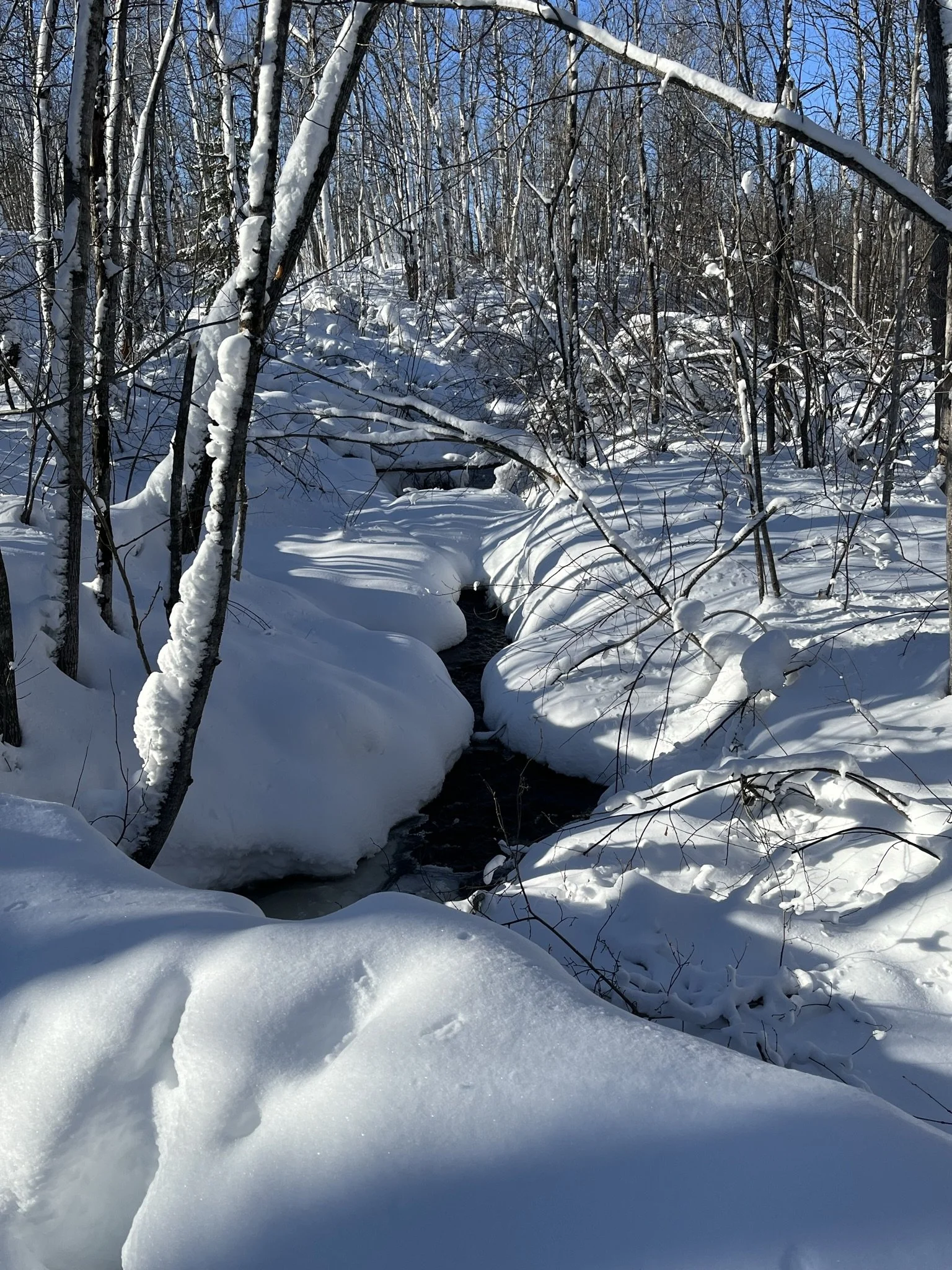
My walk in the woods on this windless day began in the particular hush that only accompanies a fresh blanket of snow. It is a peaceful stillness -- the only sound the crunch of the snow under my boots and the gentle trickling of the Amity beneath the ice. I immersed myself in the calm and tranquility of the snow-laden forest.
Then out of nowhere, first one dog, then another, then another -- startling my own two dogs. The snarling, growling, and barking began as the dogs circled round each other. I stepped off the trail trying to disrupt the fray, mostly to no avail. After several minutes the dogs’ people finally appeared to call off their dogs, rather unsuccessfully, unapologetically explaining that the one who had started it all was “young,” and slowly went on their way. I waited a long time for them to disappear and for my nervous system to settle, but the captivating calm was broken, the meditative mood dispelled.
Back in the car, all the talk on the BBC was of Trump’s attack on Venezuela – the capturing of Nicolás Maduro and his wife; the 150 US military aircraft -- F-18, F-22, and F-35 fighter jets, B-1 bombers and drones; the weeks of planning; as well as of the chaos and fear reigning in the capital city of Caracas, where panic-stricken people were lining up for food, water, and medicine in the mostly blacked-out city. Just as on my walk, the post-Christmas calm was violently disrupted when Trump unleashed the dogs of war.[1]
Granted, Maduro has been an oppressive authoritarian leader whose policies have worked to destroy the Venezuelan economy. Venezuelans in South Florida are said to have been out in the streets celebrating his capture. Nevertheless, the violent bombing of Caracas, the seizure and capture of its president, not to mention the bombing of boats off the coast of Venezuela are all acts of violent destruction and death as well as violations of international law.
In this latest act, the US violated Article 2(4) of the UN Charter, which states:
All members shall refrain in their international relations from the threat or use of force against the territorial integrity or political independence of any state, or in any other manner inconsistent with the purposes of the United Nations.
The master of unaccountability will likely never face the consequences of his actions. Like Trump, the US government has never regarded itself as needing to be accountable to the international community. While the US signed on to the Rome Statute creating the International Criminal Court of Justice in 2000, the US Senate never ratified the treaty, and in 2002 the Bush Administration announced that the US would not become a party to the treaty, citing among other things, concerns about state sovereignty – ironically, the very thing the US just violated in Venezuela.
The Rome Statute that the US has refused to be a party to is a beautifully-crafted testament to world peace, recognizing “that all peoples are united by common bonds, their cultures pieced together in a shared heritage,” as well as a concern “that this delicate mosaic may be shattered at any time.” Among its tenets are the determination to end the impunity of those who threaten “the peace, security, and well-being of the world” by their violation of four crimes of war – genocide; crimes against humanity – including the intentional killing, enslavement, deportation, imprisonment, sexual and gender-based violence, persecution, and disappearance of civilians; war crimes – including depriving prisoners of war of fair trial, the taking of hostages, and compelling a prisoner of war to serve in the forces of a hostile power; and lastly, the crime of aggression which Trump just committed – “the planning, preparation, initiation or execution” by a person in political or military power to use “armed force against the sovereignty, territorial integrity, or political independence of another state.”[2]
I imagine most people in this country would ascribe to these principles and would object to their violation. So, following my walk in the woods, I joined the rather spontaneous protest against the US invasion of Venezuela. We were a small gathering, maybe thirty in total – two groups of us – the twenty to thirty- something- year-olds who all seemed to know each other and those of us in our 70s who’ve been at this for over fifty years. I suppose those missing in-between generations were busy taking care of children, but we all were there taking care of the children by continuing to do what we can to make the world a better place for them. Looking at the young people among us, I found myself remembering those early years of anti-war protesting, never thinking I would still be doing this 55 years later. They reminded me of the group of young socialists and communists of Emma Goldman and John “Jack” Reed’s WW I generation,[3] convivially, yet doggedly determined to bring an end to US imperialism, aggression, and war -- chanting, singing -- messengers perhaps of the angels of old — “Peace on earth, goodwill to all.”
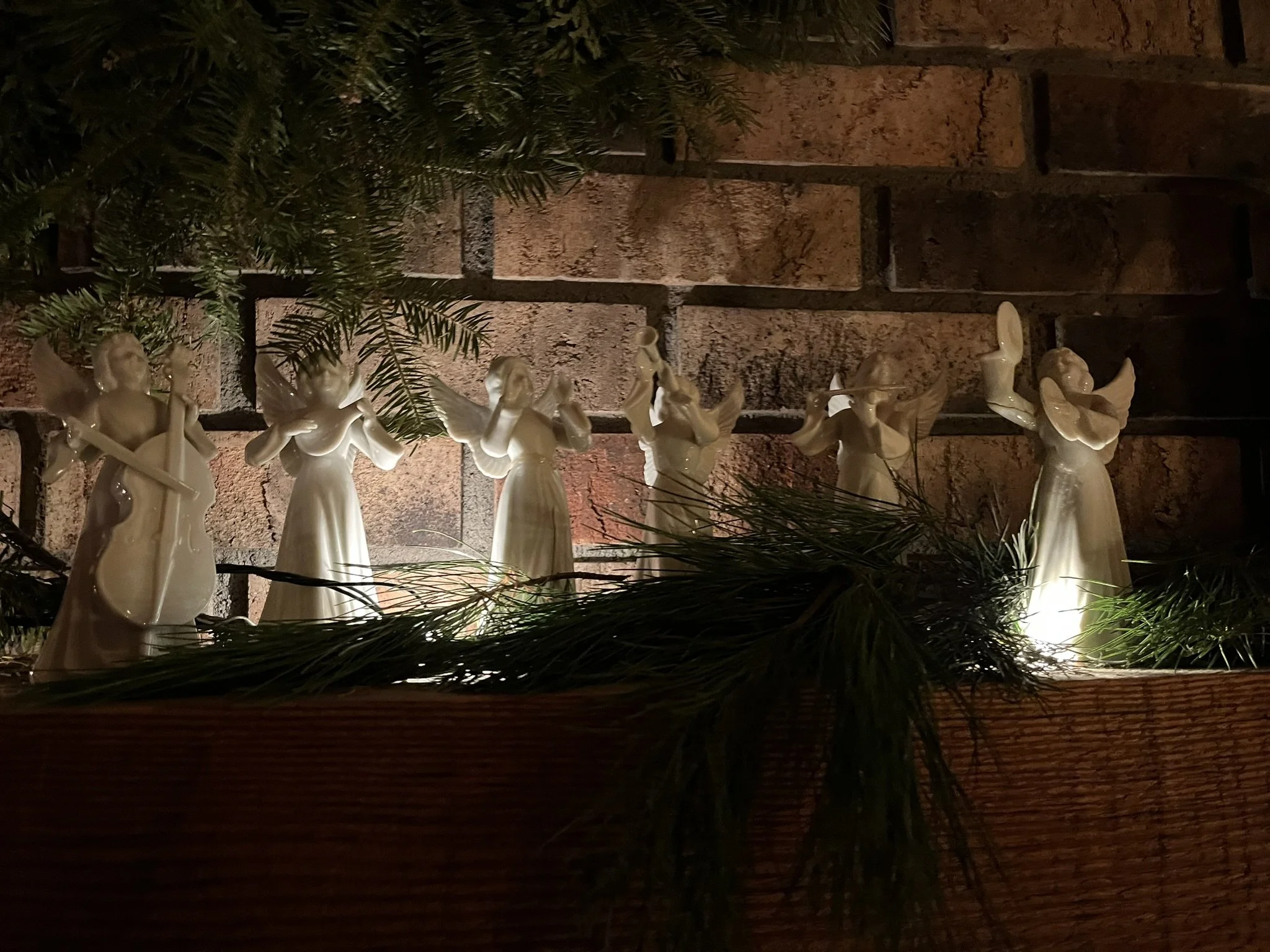
Throughout the afternoon, “It Came Upon a Midnight Clear” played in the background music of my mind, chronicling the day – “The world in silent stillness lay/ to hear the angels sing, ‘Peace on the earth, good will to men’. . . Yet man, at war with man, hears not/The love-song which they bring;/Oh, hush the noise, ye men of strife/And hear the angels sing.. . .”
Oh hush the noise, ye men of strife – and hear the angels sing.
Sources
Rome Statute of the International Criminal Court
Sears, Edmund H. “It Came Upon a Midnight Clear.” 1849.
[1] The term “dogs of war” comes from Shakespeare’s Julius Caesar, Marc Antony’s speech, Act 3, Scene 1. Originally it probably referred to the practice of using dogs in war, but has come to mean the destruction and chaos that accompanies war.
[2] Rome Statute of the International Criminal Court, Preamble.
[3] Emma Goldman and Jack Reed were among a group of idealistic young people who helped form the Communist Party in the US and were later exiled to the newly formed Soviet Union. Reed, a journalist, died in the Soviet Union of typhus at the age of 32. Goldman was an ardent pacifist who opposed the US entrance into WW I. Disillusioned by the Soviet Union, she left, traveled the w[3]orld working on anti-fascist causes, and died in Canada at the age of 70.