
Adagio – the tempo I needed today after the frenetic pace of Thanksgiving Day – preparing a multi-dish feast while balancing the needs of a two-year-old, an infant, and two dogs. Even with four adults helping to tend the children the day felt a bit wild and chaotic.
But now, in this liminal time between Thanksgiving and the work week I find myself moving at a slower pace – washing the bedding, ironing the duvet cover, putting away toys. While my email fills with urgent messages to go out and buy, buy, buy before the Black Friday deals are gone, the gently falling snow instead invites me to amble leisurely through the woods with the dogs, pausing every once in a while simply to appreciate the beauty of the flakes as they quietly float through the pines.

The snowfall is the perfect accompaniment to my annual ritual of putting up the Solstice tree during this brief hiatus from the many demands of ordinary days. Adorned with white lights, strings of popcorn, icicles, and snowflakes, something about its presence in our home bids me to set the world aside for a time and settle into the sanctity of the season.
Adagio– meaning “slower” and “at ease.” I could feel the ease settle into my body, my breathing deepening, the tension in my shoulders releasing, as I went about my day unhurried. It is the speed – or lack of – required of the Buddhist practice of mindfulness – approaching each task with deliberateness, a presence of mind, an engagement fully in the present moment. “Wash the dishes relaxingly,” wrote Buddhist monk Thich Nhat Hanh, “as though each bowl is an object of contemplation. Consider each bowl as sacred. Follow your breath to prevent your mind from straying. Do not try to hurry to get the job over. Consider washing the dishes the most important thing in life.”[i] Whenever I find myself becoming agitated with all that needs to be done in a day, I remind myself of the wisdom of mindfulness, pause, breathe, slow down, and give my full attention to whatever I am doing. Remarkably, no matter the task, what had felt like a chore becomes instead a meditation, and I can notice the Buddhist half-smile subtly, effortlessly returning to my countenance. Thay[ii] suggested that we use simple reminders throughout the day – the ring of the phone, an hourly chime, sitting down for a meal – to return us to moments of mindfulness so easily swept aside as we scurry through the many daily tasks. We can place moments of Sabbath throughout our day to mark transition times – between sleep and waking, work and home, activity of the day and retiring at night. I imagine we all would benefit from the Islamic practice of pausing for prayer five times during the day – Fajr – just before sunrise; Dhur – a pause in the workday at noon; Asr – late afternoon; Maghrib – just before sunset; and ‘Isha -- just before bed.
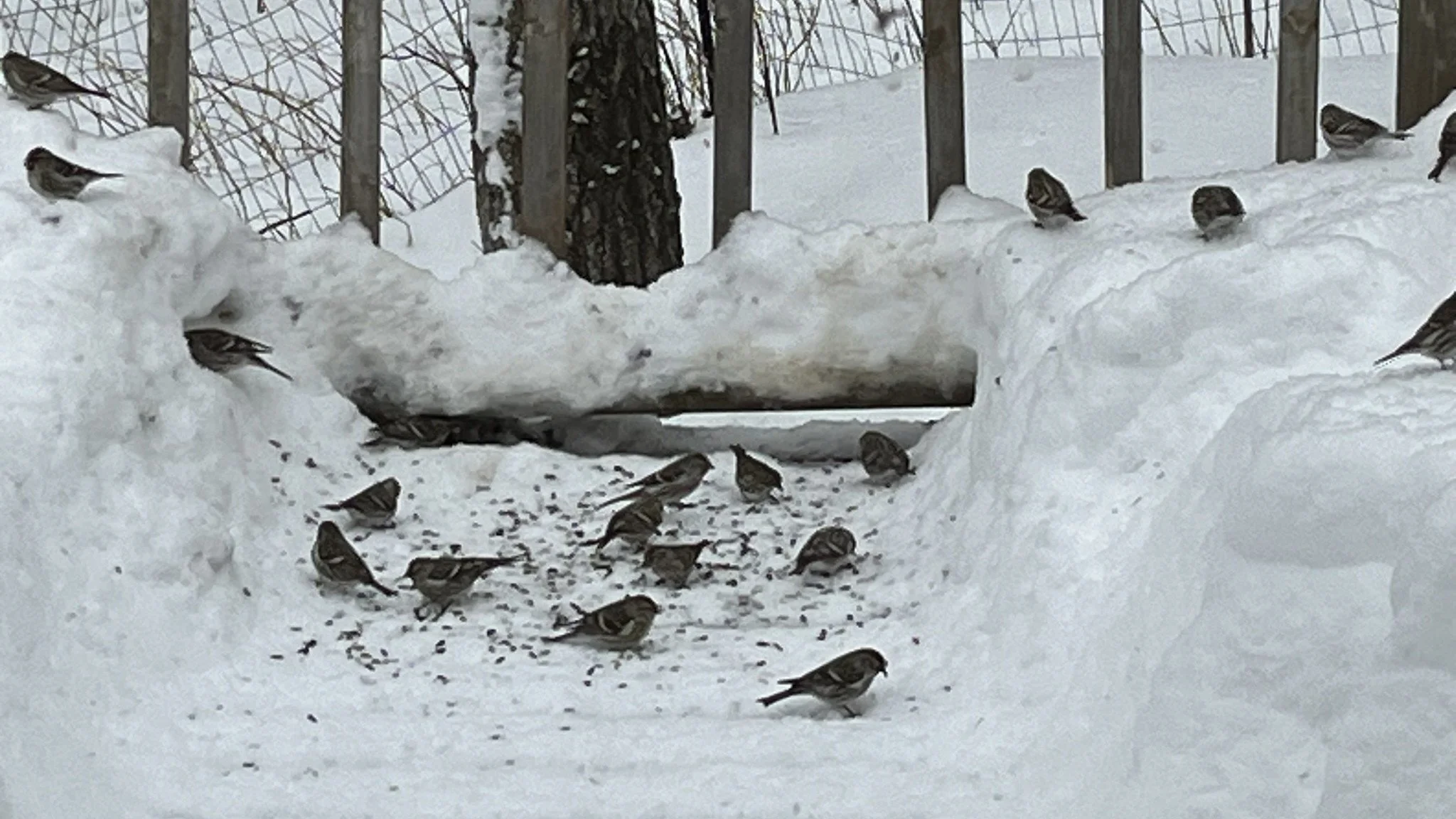
Adagio – the tempo of bird watching. Assured by our recent snow that the bears are now hibernating, I finally felt secure in putting out the bird feeder, and then wait for the birds to find it again. Watching the chickadees, nuthatches, redpolls, and finches at the feeder immediately slackens my pace and invokes calm. My sister loved nothing more than watching the birds at her many feeders. Living in Ohio, she had no concerns for bears being attracted to the bird seed so could feed the birds year-round. She had traditional flip-top feeders, a special squirrel-proof feeder, several finch feeders, suet feeders, and a heated bird bath. She could easily spend hours fully absorbed in the delight of witnessing the colorful bevy of blue jays, cardinals, goldfinches, purple finches, Evening Grosbeaks, sparrows, and chickadees that would grace her feeders and her days. When she moved into the nursing home in the last months of her life, her sons made sure that she had a bird feeder placed outside her window. I noticed several such feeders outside patient rooms. It is a standard practice now at assisted living facilities and memory care units to place several bird feeders throughout the grounds and outside windows, providing both enchantment and balm. The attention the birds entreat is itself a call to mindfulness, a meditation bell on wings.
Adagio – the tempo marking of several of my best-loved pieces of music – Debussy’s “Claire de Lune,” Elgar’s “Salut d’amour,” Massenet’s “Meditation from ‘Thais’,” and of course, Barber’s “Adagio for Strings.” The last was my mother’s favorite. Whenever the piece reached the point where it soars to its height and then goes yet higher, since she would drop whatever she was doing to make sure we were paying attention. “Listen,” she would say, her eyes sparkling with anticipation. Listen. Fully to listen – whether to music or birdsong or each other requires adagio moments – slowly being wholly present – holy present.
Adagio – the tempo of walking the labyrinth. In the final weeks of the semester between Thanksgiving and winter break, I would take students to our local retreat center. There Sister Lois would welcome us with her calming presence before we all headed out to the labyrinth -- setting our intention before entering, walking the path slowly and deliberately -- each step a prayer, grounding in the center, and attentively moving back out, quietly blessing each one as we passed. “Give yourself to the path,” writes poet Gary Boelhower, “to each step each word each moment/each small mercy each held hand/each meeting of the eyes./Give yourself and the way will find you/and guide you.”[iii]
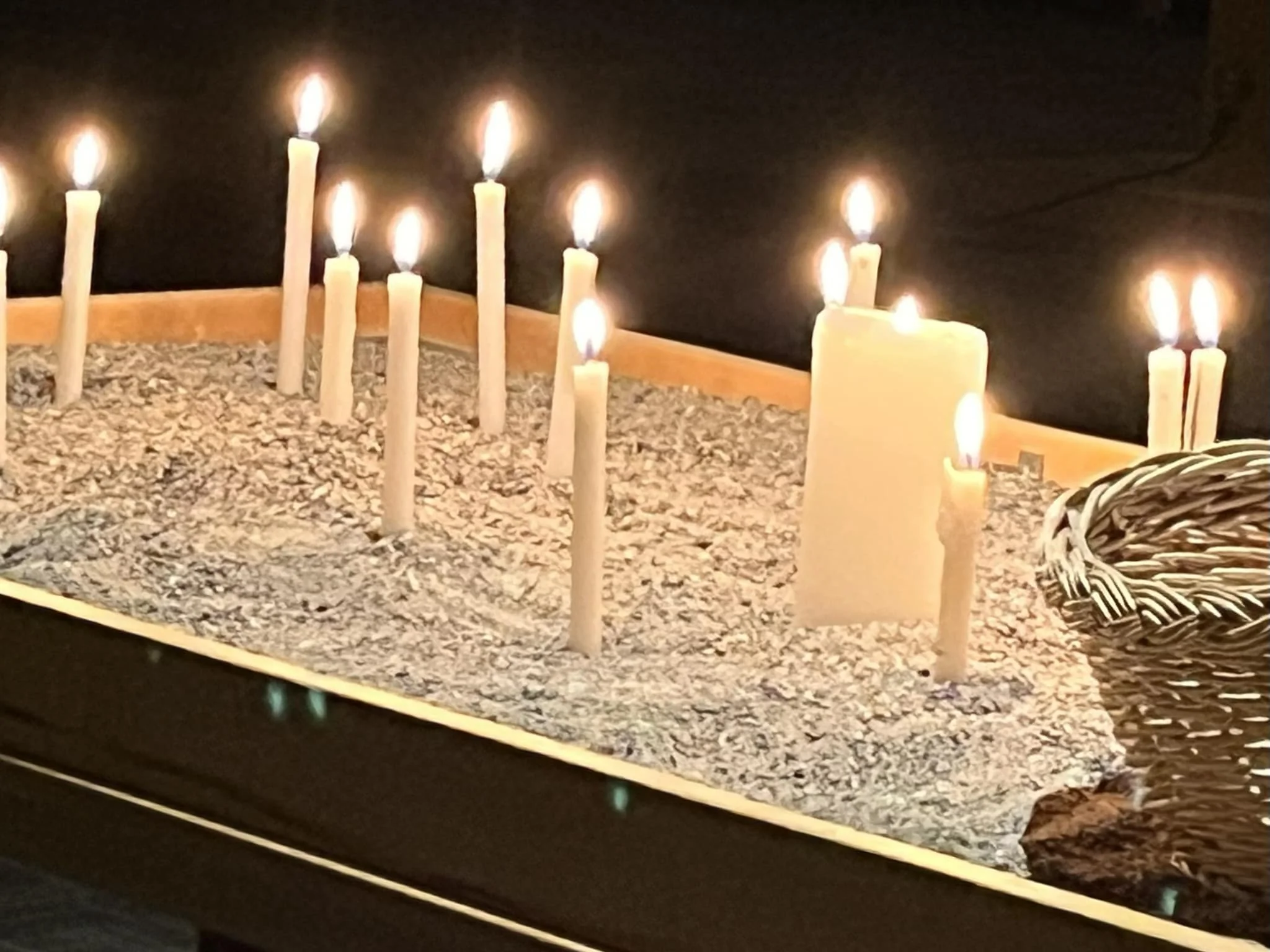
Adagio – the tempo of patient waiting – for the fog to lift, for the longed for loved one to arrive, for the dough to rise, for the seeds to sprout, for the baby to be born. On this first day of Advent we light a single candle to invoke the season of waiting, in stillness, in hope. “Advent is familiar ground for people who know the ache of waiting: for healing, for peace, for things to finally be set right,” writes theologian Kate Bowler.[iv] For many years during Advent, while softly playing the piano in adagio mode, I would witness this ache, this waiting as each person present, one by one, would light a candle. Slowly the darkened sanctuary would fill with the light of hope in each tendered prayer – “for healing, for peace, for things finally to be set right.”
Adagio – the tempo of the lighting of candles, of snowflakes drifting gently from the sky, of a cup of hot tea, of watching the stars come out one by one, of wool socks and cups of cocoa and firelight, of quiet walks in the woods and barefoot walks on the beach, of sunsets, of poetry, of a paddle on a calm lake, of a hot bath after a long hike, of the pull of the yarn over the knitting needle, of rocking the baby to sleep, of lullabies, of late-night conversation with a long-time friend, of the giving and receiving of attention, of listening, of love.
In this holiday season, may your days be graced by adagio moments.

Sources
Boelhower, Gary. Step Close In: Poems from the Path. Gates Mills, Ohio: The Orchard Street Press, 2020.
Bowler, Kate. Everything Happens. katebowler@substack.com. “Advent Day 1: Start with one candle.” 11/30/25.
Hanh, Thich Nhat. The Miracle of Mindfulness, Rider Books, 1991.