The Nightingale Walk
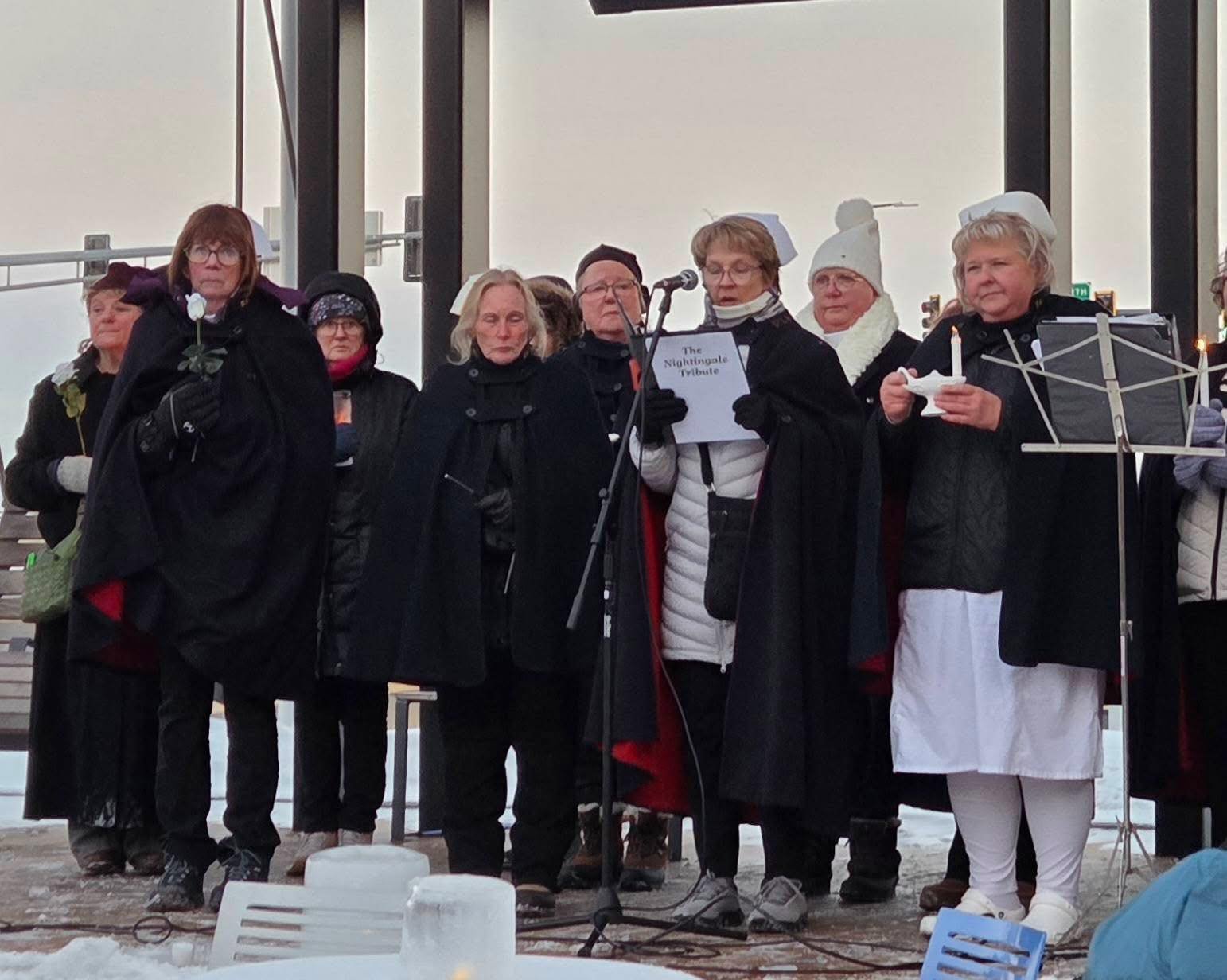
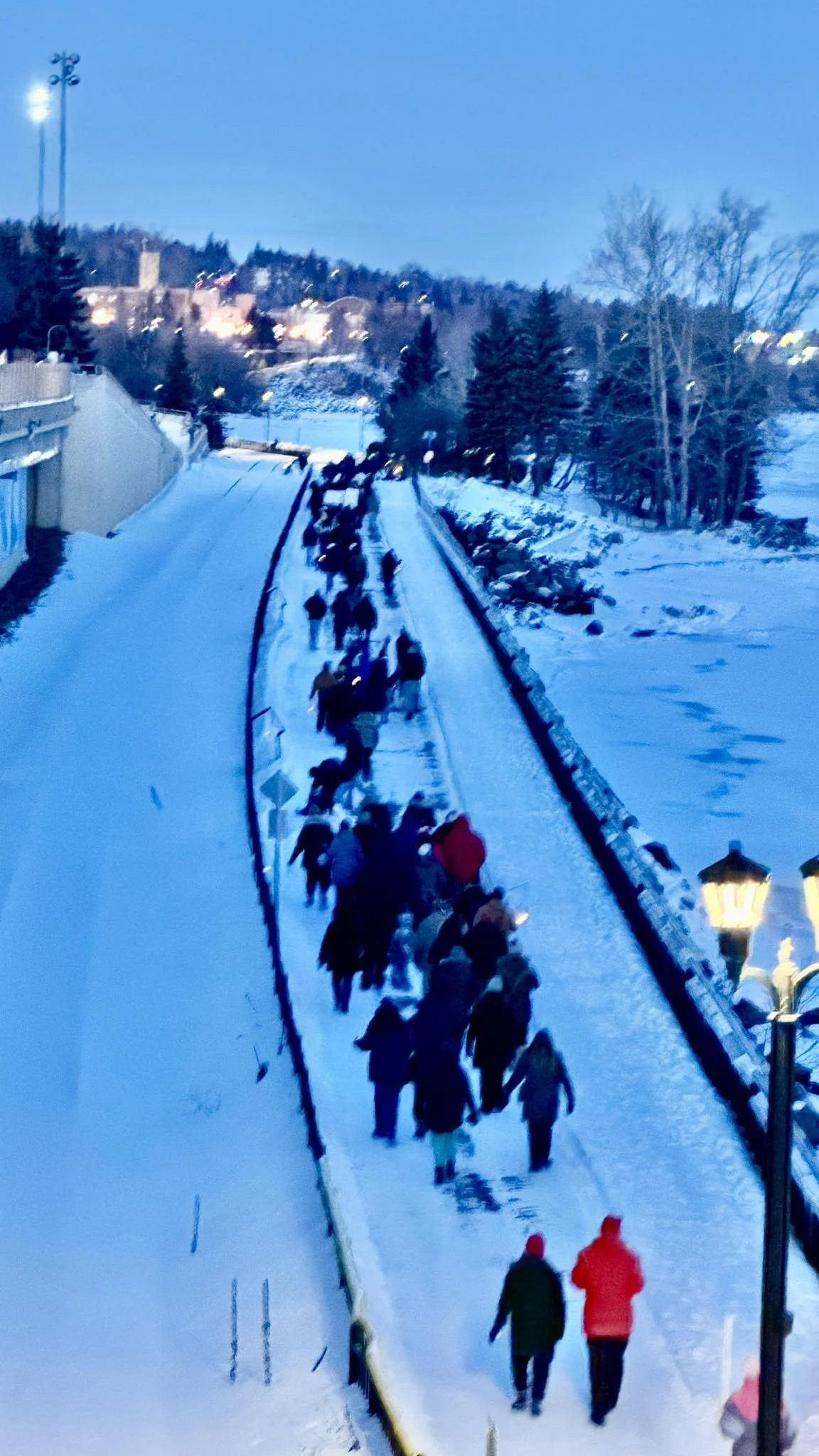
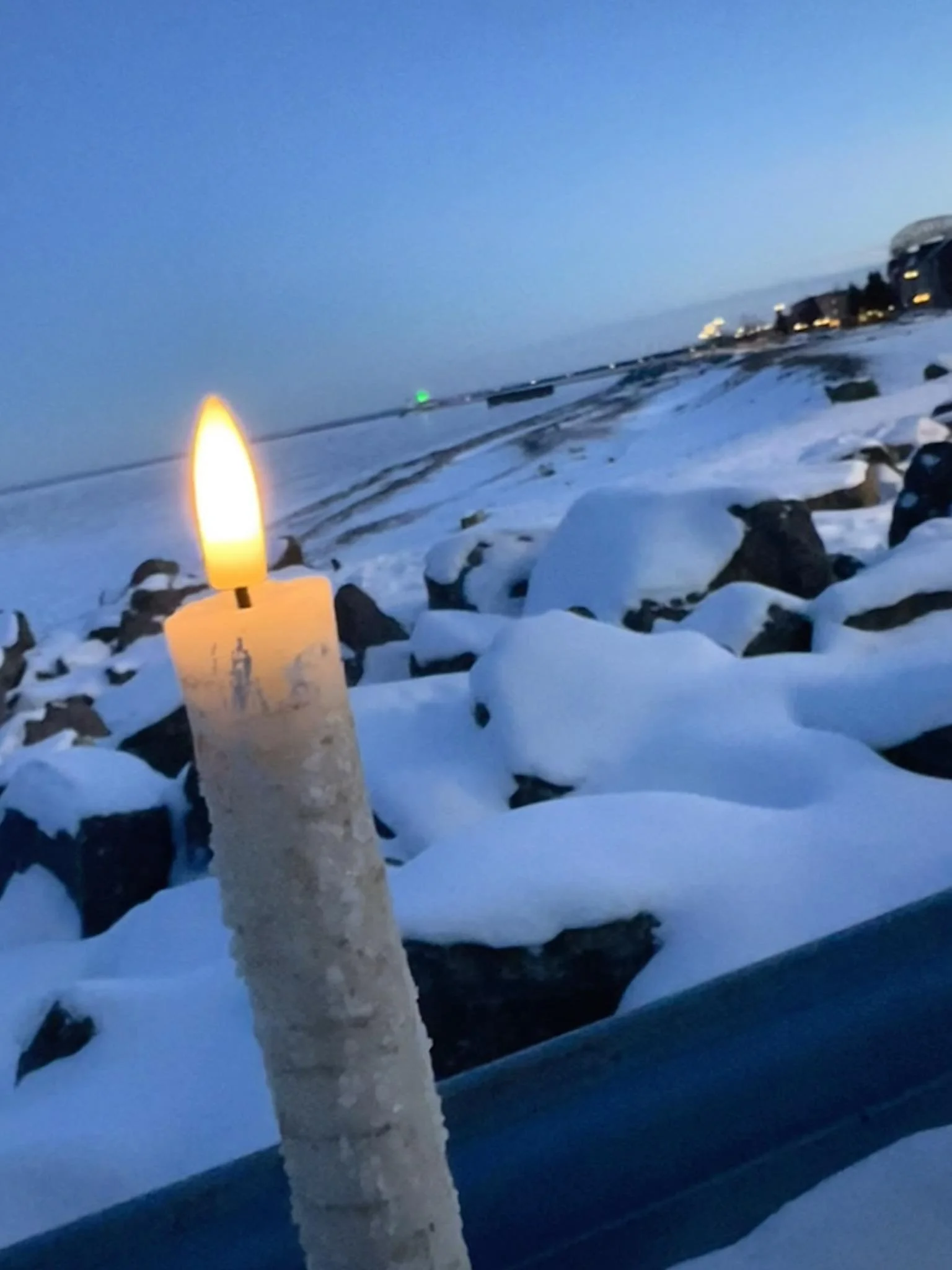
On Monday, February 2nd, a few hundred people gathered, candles lit, to honor and say farewell to Alex Pretti, the VA hospital ICU nurse who was executed by ICE agents ten days prior while trying to help a woman whom ICE agents had shoved down to the ground. Two local nurses, Erin Sather and Megan Finegan, had organized a Nightingale vigil, tribute, and walk to honor Pretti’s life and service as a nurse. They each gave opening remarks in Pretti’s honor. Finegan, a hospice nurse, spoke movingly of how she was there because Pretti had died alone, with no one holding his hand as he lay dying. “He didn’t get what he gave all his patients,” she said, “so we are here to hold him, to be with him and make sure that he is surrounded by nurses.” Then the local Nightingale Honor Guard gave Pretti a final send-off. Dressed in the formal white nursing cap, they spoke their final farewell, ringing a bell in Pretti’s honor, presenting a white rose, and finally, blowing out a candle as they released him from his duties. Those present then proceeded to the Lakewalk for a final solemn candlelit remembrance walk.
Standing there, listening to the words spoken, I was overwhelmed to the point of tears, for the needless loss of this young man’s life, yes, but mostly for the honor and gratitude I was feeling for all of the nurses who have surrounded me with care over my lifetime. I owe my life to nurses – from the ones who gave me CPR when I collapsed – twice -- in cardiac arrest, to the ones who first met and cared for me in emergency rooms, to the ones who helped me birth my baby, to the ones I never saw or met who assisted in my surgeries, to the ones who cared for me night and day during long hospital stays. It is the latter I remember the most because the others tended me when I was unconscious or during brief stays in the ER. I remember their caring for my dignity when they would come to give me a sponge bath or lift me onto the bed pan, their tender touch when they came every night to gently massage my rapidly atrophying muscles with lotion, their supporting me in my first tentative steps on the long journey of fifty steps down the hall, their attentive care. I remember one night nurse in particular who stayed to visit nearly every night, listening to my sorrows, holding me through my tears, during those long sad and lonely weeks of being away from my baby. And then there was the knowledgeable and experienced nurse who gently guided me through a critical point in my labor. When my baby was stuck on my spine and not moving down, she got me on my hands and knees and stayed by my side, encouraging me through each contraction, until finally he slipped down far enough to be birthed. The doctor arrived in time to deliver him, but I credit the nurse, whose name I don’t know and have never been able to thank, for the safe delivery of my baby boy. Dozens, hundreds of nurses have tended me, body and spirit, over weeks and months and years of my life – most of whom I will never know, most of whom, unlike my doctors, and like so many women in the Bible, remain unnamed.
But two I will always remember and honor by name – Sofia and Nancy. Sofia Ormaza was the nurse transplant coordinator when I was waiting for and received my heart transplant. She was the one who took the time to know me as a person, not just as a patient, in all those months and years of waiting. My doctors came and went over the years, but Sofia was a constant. She was the one who came to give me the bad news after my “dry run” – the term given when a patient waiting for a transplant gets the call, gets prepped for surgery, only to fail to receive the organ for one reason or another. She simply said, “The heart wasn’t good enough. We want the heart to be good enough to get you to Paul’s college graduation.” (He was four at the time.) What a hopeful, loving way to let me know that I would have to go home and wait longer. And when they did find that heart and it was implanted, Sofia was there. Several years ago now I attended a celebration of the U of M’s heart transplant program 40th anniversary. The only person I remembered and whom I so wanted to see again was Sofia. Now long retired from nursing, she was there, and we embraced and shared our great joy in seeing each other again. I never could have gotten through the long years of waiting and the transplant itself without Sofia.
I couldn’t have made it without Nancy either, a cardiac intensive care unit nurse who lived across the street. On the night I was taken by ambulance to the hospital following a cardiac arrest, Nancy was on duty. She walked in to find me being worked on. We were more than neighbors. We were close friends, family really, and she had to recuse herself from working on me. It was too close. But she was there caring for me every step of the way for years. When she went to bed every night she laid out clothes to put on in case we called in the middle of the night. And we did – the several nights she drove me to the ER while Dave stayed with our little boy; the night pre-transplant that I accidentally overdosed on my meds and she spent the night next to me in my bed just in case; the night I had a TIA and woke up paralyzed on my entire left side; and the evening when my heart went into V-tach and she held my hand while waiting for the ambulance -- my defibrillator shocking me over and over the entire time. I hope she wasn’t shocked every time I was.
Nurses -- the mostly unsung heroes who provide the bulk of hands-on care for the sick and dying. They are the ones who deal with the mess of bodily fluids, who change the sheets, who check the vitals, who are alert to the small changes that might signal a critical need, who hold the hands and stroke the foreheads. who swab the parched mouths in the final days and hours.
It is a profession I have long admired. While other girls were reading Nancy Drew mysteries, I read Cherry Ames mysteries – Cherry Ames: Student Nurse, Cherry Ames: Senior Nurse, Cherry Ames: Army Nurse, and on. And among my favorites of the many children’s biographies my mother gave me were the “little orange book” about Clara Barton, the Civil War nurse who founded the Red Cross, and the story of Edith Cavell, a British nurse celebrated for her devoted care of soldiers on both sides of the conflict, and executed by the German army for her part in helping 200 Allied soldiers escape from German-occupied Belgium.[i]
And though I chose not to follow it, it is a calling I still feel a longing for. Of all the badges I earned in Girl Scouts, my favorite and the one that has been invaluable to me was the Red Cross first aid badge. I learned what to do for bruises and cuts, how to splint broken bones and tape sprained ankles, how to make a bed with hospital corners, how to perform CPR. I loved it. Even now, I’m at my best when tending to a sick or injured loved one, including my dogs. When the pandemic first hit, all I wanted to do was be in the midst of those caring for the sick and dying. I ached for my inability to do so, prohibited first and foremost by being immunocompromised, but also having never acquired the skills.[ii]
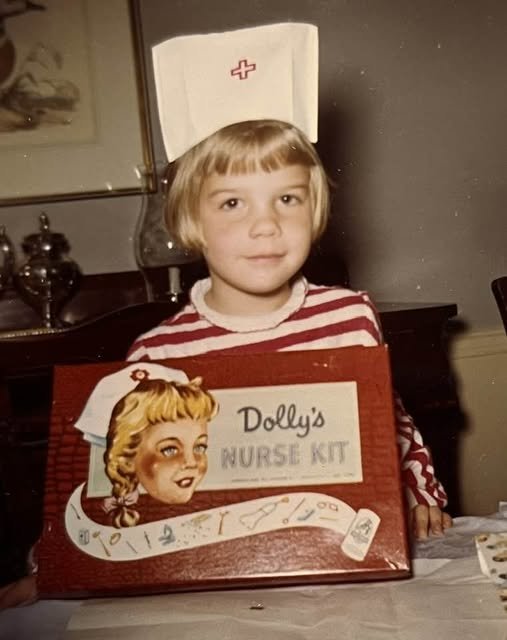
There was a time when I might have followed the path into nursing. On my fifth birthday, I received the present I’d been wanting for so long – my own nurse kit. The mock nurse’s bag came complete with a pretend stethoscope, syringe, thermometer, watch, gauze bandages, tongue depressors, and of course, a white nurse’s cap. At some point I even had a complete nurse’s uniform. I played nurse on my dolls and I imagine on my brother from time to time. Then came the fateful day when I asked my dad, a surgeon, if I could help him with the minor surgery he was about to perform on my older brother in the bedroom. My brother had stepped on a needle which had broken off and was still partially imbedded in his foot and my dad was going to cut open his foot and take the broken needle out. I donned my nurse’s uniform and excitedly joined my dad as he cut open my brother’s foot. I was fascinated by what a foot looks like inside – the color and texture of the layers of fat and muscle. Under different circumstances I may have found my calling, but I clearly remember that was the day that I decided I never wanted to be a nurse because I didn’t want to be bossed around by doctors, which apparently my dad had done to me that day. I now know nursing is so much more than that. (And hopefully, doctors treat them with the equal regard and respect they deserve.)
Nursing is a highly skilled profession, something that is so often unappreciated or downplayed, as in the recent decision by the Trump administration’s Department of Education’s decision no longer to consider nursing a professional degree. Certainly, nursing has never carried the same kind of esteem or monetary reward as has being a physician, yet the knowledge and skills nurses acquire are vital to providing life-saving, healing, supportive, and, at the end of life, palliative care. Above all, nursing is a caring profession. The many meanings of the word ‘nurse’ as a verb speak plainly of the work of nurses – “to give medical attention to” – the most obvious, yes, but these others as well – “to treat carefully and protectively,” “to hold closely and carefully,” “to take special care of, especially to promote development of well-being.” At heart, a nurse is someone who provides comfort and care.
Most often it seems nurses do not receive the respect and recognition that is their due, so I was glad to see so many provide that for Alex Pretti. I would hope that every nurse experiences that regard not just at the end of their lives, but in the everydayness of their work as well. I know they are often the ones who bear the brunt of their patients’ frustrations and pains with little of the reward. But I would light a candle in their honor every day. With utmost respect and gratitude – thank you.
[i] As I write this, I’m struck by the parallel with Alex Pretti, executed by an occupying military force, simply for caring for a fellow constitutional observer.
[ii] All the reasons that I didn’t pursue that path are another story for another time.
Photo Credits: Nightingale Walk, Terese Tomanek; Candle, Jennifer Haskins Hellend; Nightingale Honor Guard, Kate Nicoletti FB post, 2/3/26 - photographer unknown.