There is a principal of benevolence in man which prompts him to an equal pursuit of the happiness of all.
- Lord Kames
The general happiness is the supreme end of all political union.
- Frances Hutcheson
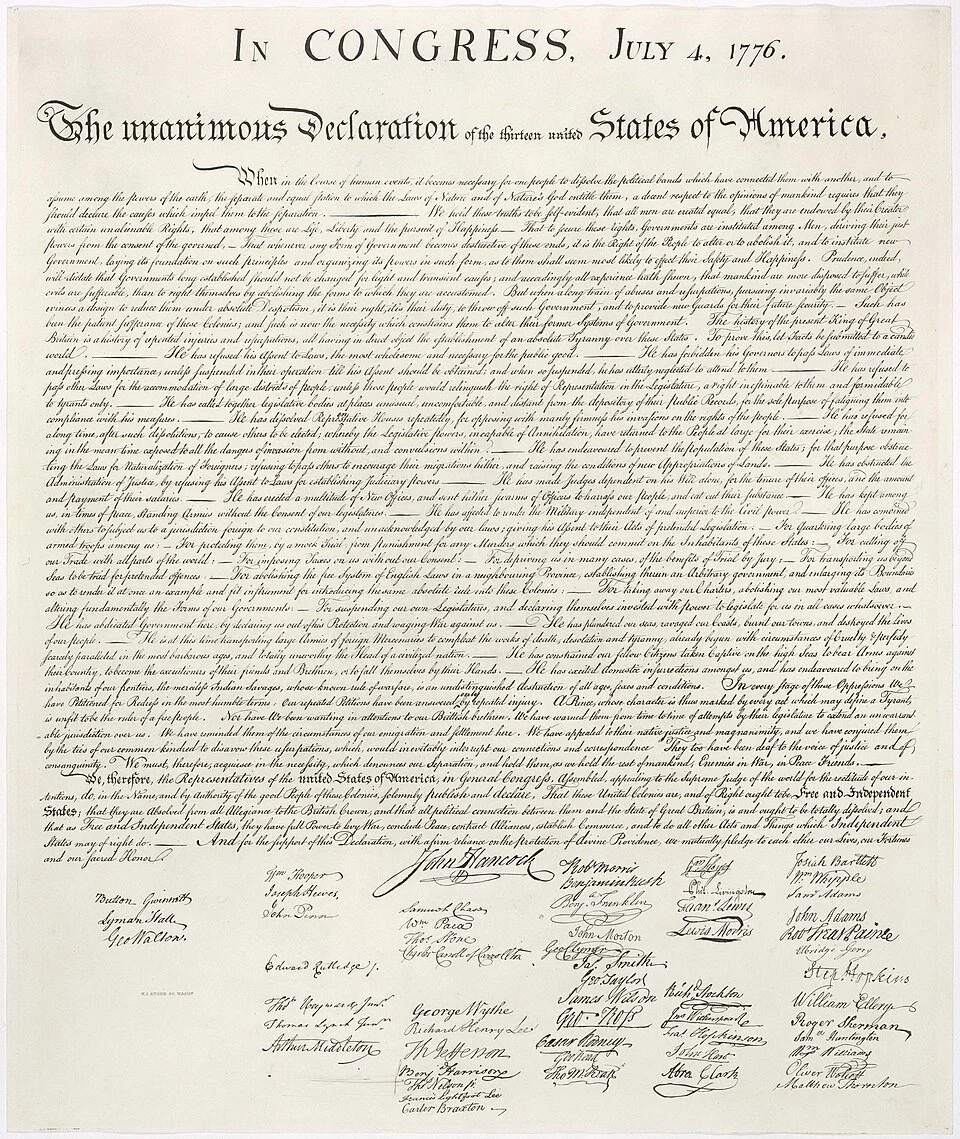
Every 4th of July when I was a child my mother would read the Declaration of Independence out loud. I imagine she only read the preamble and not the list of grievances – many of which could be leveled at our current administration – such as “He has made judges dependent on his will alone . . .; “He has . . .sent hither swarms of new officers to harass our people . . . ”; and “He has kept among us in times of peace standing armies without the consent of our legislatures.” Certainly what I remember most are the words of the Declaration that are most often referenced: “We hold these truths to be self evident, that all men are created equal, that they are endowed by their creator with certain inalienable rights; that among these are life, liberty & the pursuit of happiness. . . .”
These last words from the preamble – “life, liberty, and the pursuit of happiness” —have come to define the American character. However, my sense is that many if not most people in the US have wrongly conflated the last phrase, “the pursuit of happiness,” with the accumulation of “stuff” – not just homes with white picket fences, but cars and boats, big screen TVs and the latest electronic gadgets, shoes and clothes and jewelry and any manner of toys for children and grownups. . .. And so, “life, liberty and the pursuit of happiness” have come to be used to affirm every individual’s right to consume, accumulate, and even destroy property, wealth, and as much stuff as possible with no regard to the common good.
This interpretation, which undergirds US individualism and the untrammeled pursuit of greed and gain, is far from the intended meaning and actually makes little sense. As historian Garry Wills wrote, “Men may wish to be millionaires; but it is politically silly to make that wish a right.”[i] It has been wrongly assumed that by “happiness” Jefferson actually intended “property,” drawn from the Lockean triad of the rights of “life, liberty, and property.” Because of its assertion of the right of the people to popular sovereignty and emphasis on governments based on a social contract, John Locke’s Second Treatise has often mistakenly been assumed to be the source of the ideas in the Declaration.
However, Jefferson was not a particular fan of Locke. Rather, he was educated in the works of Thomas Reid, Frances Hutcheson, David Hume, and other philosophers of the Scottish Enlightenment known as “moral sense” theory.[ii] Far from being an Enlightenment document with a stress on individualism and an emphasis on private property, the Declaration of Independence is a “moral sense” document grounded in the greater good of the people as a whole.
The central grounding premise of moral sense theory is that we are social beings designed to live together in community. We derive our sense of right and wrong not from reason and natural laws, but rather from the moral sense, which is a sense of morality inherent equally in every person, regardless of race, intellect, wealth, sex and gender. As Jefferson wrote: “’This sense is as much a part of his [a person’s] nature as the sense of hearing, seeing, feeling; it is the true foundation of morality. It is given to all human beings. . . . State a moral case to a ploughman and a professor. The former will decide it as well and often better than the latter because he has not been led astray by artificial rules.’”[iii]
Unlike the Enlightenment theorists Thomas Hobbes and John Locke, moral sense theorists did not regard individual self-interest as the basis of morality. Far from it, for a basis in self-interest legitimizes avarice and ambition regardless of others, the very opposite of moral sense beliefs. Instead, they believed we are designed to be most concerned about the welfare of others. As Jefferson wrote in a letter to John Adams: “’ . . . every human mind feels pleasure in doing good to another . . . . The essence of virtue is in doing good to others.’”[iv] Thus, our very happiness lies in the welfare of others.
All of the “inalienable rights” are based in this. As Frances Hutcheson argued, the right to life is “a necessary precondition to doing good”[v] because no one can be benevolent to others without being alive. The same is true of the right to liberty, that we may be free to do good to others. Let that sink in. So often it seems that freedom in this country is touted with a “f##k you” attitude. (The January 6th insurrectionists come to mind.) Imagine instead people clamoring for the freedom to be kind, benevolent, generous, compassionate – the people wanting to bring water to others standing in line for hours to vote, to bring food and medical supplies to immigrant neighbors afraid to leave their houses, to observe and document ICE agent arrests, to provide the best medical care possible, to support their children’s sense of self, to protect the earth and water.
And so, we come to the “pursuit of happiness.” For Jefferson, “pursuit” is one’s natural calling, as much an inborn necessity as a compass needle must point north. As Wills wrote, “When they [men in the 18th century] found what they must pursue, they knew they had a right to pursue it.”[vi] And what they must pursue is happiness, the happiness that comes from engaging in virtuous and benevolent acts for the good of others. Our happiness is derived from acting to promote the happiness of others.
Moreover, the same is true of those who would come together to frame a government. Happiness in this sense is the great aim and test of good government. As I quoted Hutcheson at the beginning, “’The general happiness is the supreme end of all political union.’”[vii]
I have often wondered how different this country might have been if the original meaning and intent had been understood, if we had adopted this understanding of the pursuit of happiness, as well as life and liberty, as our national ethos – that in all of our actions and policies we were promoting the welfare, well-being, and happiness of all; that our actions as individuals and as a government were directed by benevolence.
What would a benevolent government look like? It would want its citizenry to be healthy, educated, housed, well-fed with opportunities for meaningful employment and social engagement, access to clean air and drinking water, to have freedom of belief, self-expression, and the freedom to love, and do all in its power to foster and support these. I am reminded of what feminist theorist bell hooks wrote of a nation grounded in a love ethic: “Concern for the collective good of our nation, city, or neighbor rooted in the values of love makes us all seek to nurture and protect that good. If all public policy was created in the spirit of love, we would not have to worry about unemployment, homelessness, schools failing to teach children, or addiction.”[viii]
It sounds almost utopian, but this was the world the moral sense theorists understood to be our natural inclination and undoubtedly what Jefferson had in mind when he enshrined life, liberty and the pursuit of happiness as inalienable rights. They believed that if left to our best devices we, as individuals and as a nation, would always act with benevolence and seek the greatest good for all – a worthy goal for a revolution.
Sources
hooks, bell. All About Love: New Visions. New York: William Morrow and Company, Inc., 2000.
Wills, Garry. Inventing America: Jefferson’s Declaration of Independence, with a New Introduction. New York: Houghton Mifflin, First Mariner Books, 2002.
[i] Ibid., 246.
[ii] My use of the “Scottish Enlightenment” in distinction from “the Enlightenment” may be confusing. The “Enlightenment,” also referred to as the “Age of Reason” was an intellectual movement in Europe in the 17th and 18th centuries centered on the use of reason to discern natural laws, such as the rights to life, liberty, and property. It challenged the divine right of kings, arguing that it is reason, not a divine monarchy, that allows us to determine how to govern. Some of the main political philosophers associated with the Enlightenment are Thomas Hobbes, John Locke, and Jean Jacques Rousseau. The “Scottish Enlightenment,” also known as “moral sense theory” was based entirely in Scotland, and argued that it is the moral sense, not reason, that enables us to discern how best to govern. Some of the main political philosophers associated with “moral sense” are Thomas Reid, Frances Hutcheson, and David Hume, as well as Thomas Jefferson and the 19th century feminist, Frances Wright. How a moral sense squares with the fact that Jefferson had slaves despite his original draft of the Declaration condemning slavery and his despicable characterization of Native Americans in the Declaration is a much more complex and worthwhile discussion.
[iii] Jefferson, Papers, 12:15, quoted in Wills, 202-203.
[iv] Jefferson to Adams, in Lester J. Cappon. The Adams-Jefferson Letters. Chapel Hill, 1959, quoted in Wills, 204.
[v] Wills, 216.
[vi] Ibid., 247.
[vii] Hutcheson, A System of Moral Philosophy, Vol II, 1755, 226. Quoted in Wills, 252.
[viii] Hooks, All About Love, 98.